Welcome back to Knitted Fabric.in! When you are sourcing, designing, or simply trying to understand the quality and weight of a textile, one term dominates the conversation: GSM. This metric is arguably the most crucial factor in determining how a knitted fabric will look, feel, and ultimately, how it will be used.
Defining GSM
GSM stands for Grams per Square Meter.
- Grams (G): A unit of weight.
- Square Meter (SM): A unit of area (1 meter X 1 meter).
Simply put, the GSM of a fabric tells you the mass (weight) of the fabric if you cut it into a square meter section. It is a universal unit used across the textile industry to measure the density or substance of any fabric, whether woven or knitted.
Why is GSM Crucial for Knitted Fabrics?
For knitted fabrics, which are valued for their stretch and drape, GSM is more than just a weight measurement—it dictates the fabric’s practical use and performance:
- End-Use Determination: The primary function of the fabric is defined by its GSM. For example, a low GSM jersey knit is perfect for summer T-shirts, while a high GSM fleece knit is required for winter jackets.
- Costing and Pricing: Raw material cost is directly tied to weight. Higher GSM means more yarn was used per square meter, resulting in a higher cost for the fabric.
- Handfeel and Drape: A lower GSM fabric is generally lighter, thinner, and drapes more loosely. A higher GSM fabric is thicker, heavier, and feels more substantial, often exhibiting better warmth and shape retention.
- Opacity: Lower GSM fabrics (e.g., 100 GSM) are often sheer or semi-transparent, whereas higher GSM fabrics (e.g., 280 GSM) are opaque.
GSM Ranges and Common Uses
GSM is a sliding scale. Here is a general breakdown of how GSM ranges correspond to common knitted garments:
| GSM Range (Approximate) | Fabric Characteristics | Typical Knitted Product Uses |
| 80 – 130 GSM | Very light, sheer, fine knit. Highly breathable. | Inner linings, lightweight scarves, thin summer vests/camisoles. |
| 140 – 180 GSM | Light to medium weight. Standard T-shirt quality. | Summer T-shirts (jersey knit), lightweight polo shirts, everyday dresses. |
| 190 – 240 GSM | Medium to heavy weight. Good opacity and structure. | Quality polo shirts (pique), comfortable leggings, thicker long-sleeve T-shirts. |
| 250 – 350 GSM | Heavy and substantial. Excellent warmth and durability. | Sweatshirts (fleece, French terry), hoodies, jackets, heavy knitted joggers. |
| 360+ GSM | Very heavy, dense knit. Maximum warmth and structure. | Heavy winter coats, thick blankets/throws, specialized outerwear. |
How to Measure GSM Accurately
Measuring GSM accurately requires precise tools and a standardized method to ensure the result is consistent and reliable. The fundamental principle is to weigh a small, precisely cut sample of the fabric and then scale that weight up to determine the weight of a full square meter.
1. The Tools Required

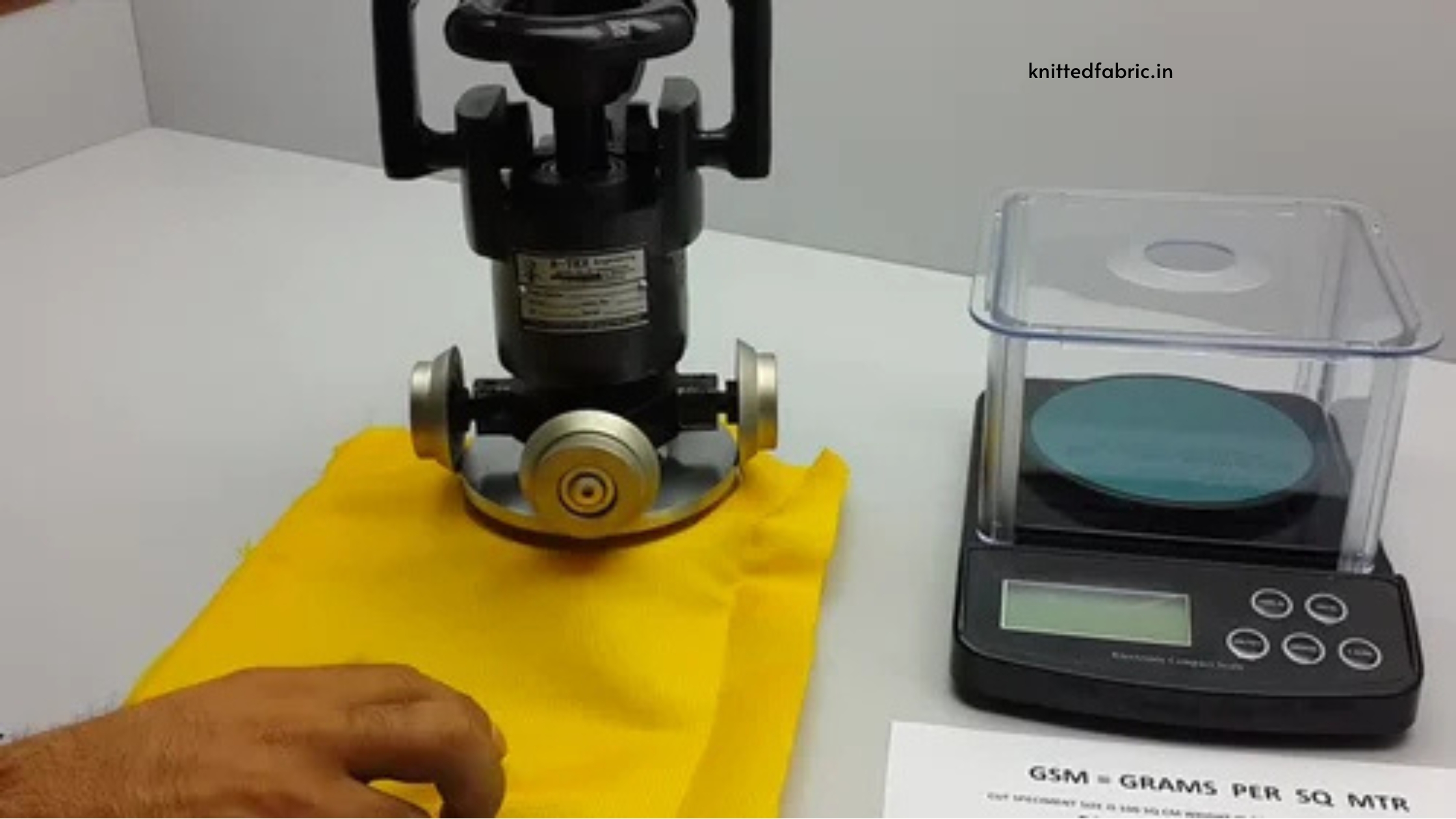
- GSM Cutter (Circular Fabric Cutter): This specialized tool is essential. It is designed to cut a precise circular sample of fabric with a known area. This area is almost always 1/100th of a square meter (100 cm2).
- Precision Digital Weighing Scale (Balance): This scale must be capable of measuring weight accurately to at least two decimal places (e.g., 0.01 grams).
- Cutting Pad: A rubber or cork mat to protect the cutter blade and the surface underneath.
2. The Step-by-Step Measurement Procedure
Step A: Conditioning
The fabric must be tested under standard atmospheric conditions (standard temperature and humidity, usually 20° C and 65% Relative Humidity). Moisture absorbed by the fabric can drastically affect its weight, so it’s critical to allow the fabric to “condition” (stabilize) in a controlled environment before testing.
Step B: Cutting the Sample
- Place the fabric flat and wrinkle-free on the cutting pad.
- Place the GSM cutter firmly on the fabric.
- Press down and rotate the cutter’s handle to cut a perfect circular sample.
- Remove the sample carefully using tweezers (to avoid adding skin oil/moisture).
Step C: Weighing and Calculation
Since the standard GSM cutter cuts a sample that is 1/100th of a square meter (100 cm2):
- Weigh the cut fabric sample on the precision digital scale.
Weight of Sample = W grams. - The calculation is then straightforward: to find the weight of 1 square meter, you simply multiply the weight of the 1/100th square meter sample by 100.
GSM = W X 100
Example: If the cut sample weighs 1.85 grams, the GSM is 1.85 X 100 = 185 GSM.
This method is widely used in calculating GSM of knitted fabrics that gives accurate result. It is easy to use and widely accepted in the knitting and textile industry. Some people also measure GSM by cutting the fabric into sqaure or rectangular shape that gives area measurement as 100 cm2.
Understanding GSM allows you to compare fabric quality accurately and ensures you choose the perfect knitted fabric for your specific needs, whether it’s a light tee or a heavy fleece!